


St Chad’s Church has watched over Poulton town centre and the Market Square for over 900 years. It occupies a lovely spot, surrounded by the church yard and gardens.
Peace and Quiet at St Chad’s Church
Whether you’re religious or not, there’s a feeling of peace and calmness in the churchyard, even though it’s sited in the middle of the hustle and bustle against the market square and the bus stops.
Once in the gardens surrounding the church a sense of calm exists – welcome in this busy world. Sit there in the sunshine and enjoy an ice cream or two minutes of relaxation. Have a slow stroll through the grounds, listen to the birdsong, and recharge your batteries.
Of course the church is also open for quiet prayer and reflection, apart from times when services are carried out. St Chad’s has groups for children including Brownies and Guides, along with Mothers Union and Ladies Fellowship and more. Pop in and find out more.

Graveyard and Old Gravestones
In 1881 Poulton Cemetery opened at Moorland Road. Soon after, on 30 June 1884, St Chad’s Graveyard closed to new burials. Since the 1950’s the ashes of the cremated have been interred to the West of the Church in a special area. By 1973 the churchyard was almost completely covered in horizontal gravestones. Most of them were lifted and made into the pathways we still use today.
These gravestones from the past are hidden in the greenery. Dozens of old memorial gravestones, ome forming the route that you tread. Slow down and take a minute to marvel at the world these people once lived in.

It’s fascinating to read how old they are, what people in days gone by did for a living, and what they died of. It seems so remote to this day and age. As you use the footpath through the gardens as a shortcut from one side of town to the other, just pause to have a look. Some of them are very old – like the next one from 1806.
FREE Newsletter
FREE Newsletter


Have you found the Pirate Grave?
Legend has it that there’s a Pirate Grave in St Chad’s Churchyard. Local folklore dictates that ‘if you spat on the skull’ it would bring you good luck.
We followed the instructions and went in search of the Pirate Grave –

It’s actually an 18th century gravestone with a, by now very faded, image of a skull and an hourglass. At the time they were images of death. The gravestone is that of a rich Poulton merchant called Edward Sherdley who died in 1741.

Your Pirate Tales…
All this talk of pirates certainly sparked your interest!
“Your video about the Pirates grave stone brought back memories. My cousin who lived in Eaton Way Poulton moved to Germany many years ago. But her son, who is now almost 50, came over when a teenager to have a guided tour around the churchyard where his grandparents ashes are buried. They were told by the guide that folklore has it that “If you spat on the skull” it would bring you good luck. They all did. I wonder if the guides still say that. Keep up the wonderful videos.”
Nigel, Isle of Man
“The pirates grave is a myth.Yes there is a stone by the vestry door with skull and crossbones. But as I understand it, the design was decorative in the style of the times when doom and foreboding lay in wait for you if you didn’t lead a good life. A reminder that all flesh is mortal!”
Astonished Celt, comment left on our YouTube video
To be fair, nearby Skippool was a major trading port at the time, so it’s likely there were pirates in these parts.
“The skull and crossbones and hourglass are masonic symbols signifying the passage of time. The funeral directors in Thornton Village have a large clock on the gable end which probably signifies something similar (time and tide wait for no man!) Also, you mention that the guy was a wealthy merchant which would fit in with him being a freemason. Freemasonry officially began in 1717 in England but the masonic building in Poulton Market Place says 1256 over the door. Interestingly, many of the dates you read out on the gravestones are close to 1776, the year of the American Revolution, which was most probably started by the freemasons!”
John, comment left on our YouTube video
Crocus Time at St Chad’s
The church grounds are famous for the display of crocus – they herald the arrival of Spring each year.

Depending on the weather, February into March is a good time to see this amazing display. A carpet of purple coats the ground from the Market Place to Chapel Street.
Take a look at a full gallery of crocus photos here. And here’s a video of them, made on a glorious morning in March –

Have you got any idea how long the crocus have been there? Can you remember a time when there weren’t any? Please leave your comments below.

The gardens are a beautiful centrepiece to a town that prides itself on its floral achievements. All through the year there are changing views, as first the spring bulbs flower, then the trees come into leaf. Then summer plants carry on the show.
History of St Chad’s Church
The history of the Poulton area dates back hundreds of years. The oldest settlements of Poulton, Kirkham and Lytham began to grow in the early 400’s.
There’s some evidence of Christian churches in the area well before the Norman Conquest of 1066, possibly including St Chad’s. The earliest reference to a church is from 1094, so it’s likely that there was an Anglo Saxon church here.
Who was St Chad?
St Chad was a 7th century founder who died on 2 March 672 – with a name for walking everywhere.
First the Abbot of Lastingham, then he later became the Bishop of Mercia. Poulton’s first church was later dedicated to him.
Earliest References
In 1094 St Chad’s was presented to the Benedictine Priory of St Mary at Lancaster. Incredibly, by 1096, it as also declared the third richest in Lancashire.
In 1287 the Vicarage was built and the tithe barn. There people handed over their ‘tithe’ to the church – one tenth of their earnings (or productivity) in that year. The tennis courts are now where the tithe barn once stood.
Interesting then that by 1602 when the chancel collapsed it was due to a lack of money… The tower appears to date from 1636 – and a carved stone in the vestry commemorates it.
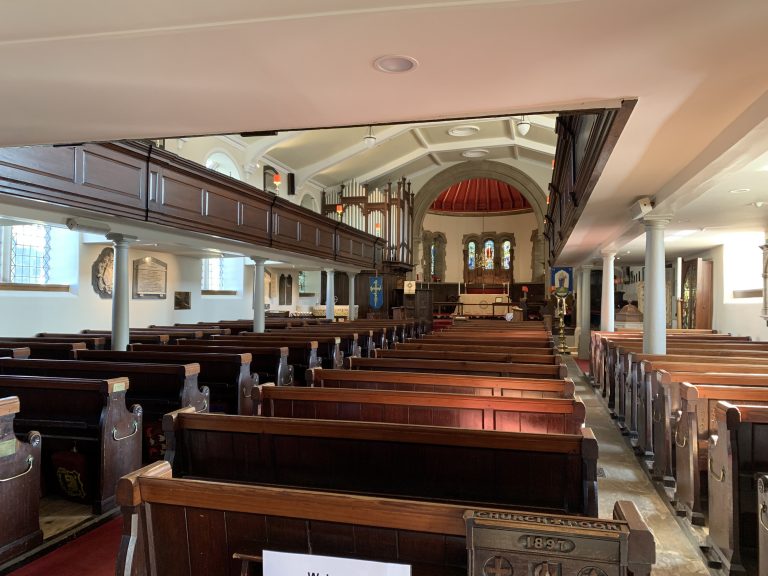
In 1751, the existing medieval church was extensively rebuilt to form the mid 18th century church that still stands there now. During the 1751 restructure, the outer red sandstone walls of the original building were faced with grey ashlar stone to modernise the look of it. The 1636 tower was retained and modernised. The Eastern Gallery was moved and rebuilt on the Western wall. Two new side galleries were added too.
Does the Pancake Bell still ring? On Shrove Tuesday, pancakes were made and served to the towns apprentices – after the bell rang at 11am. A day of jollity it featured cock fighting and bear or bull baiting…
There’s evidence of history all over the church. The panelled pulpit is Jacobean and dates from the early 18th century.
Alterations through the Years
Alterations to St Chad’s Church have happened numerous times over the years. Just like we change things today.
- The chandelier above the altar was specially made for St Chad’s in 1710.
- In 1753 the knave was rebuilt
- 1868 saw the semicircular apse added
- Until 1883 an assortment of box pews existed throughout the church, each with their own brass name plate. A few still remain upstairs.
- The baptistry was built in 1883, and the organ moved to the choir stalls
- Interior work carried out in 1908
- In 1955 work to the central aisle and replacement of the Victorian pulpit
- And in 2005 a small extension is built to the north of the Tower.
- The Church Hall (now known as Vicarage Park Community Centre) was built in 1925 and refurbished in 2015.

Evidence of the Past
At the back of the church is a carved wooden pew screen and a small door dating from the 17th century. They were originally part of the pews of the Fleetwood’s and Rigby’s. At the time of the Reformation in 1538 the Fleetwood family were patrons of the church.
Set in the south wall is the door to the Fleetwood Hesketh family vault where around 30 members are buried. The first one was Richard Fleetwood in 1699. His name and date are carved into the stone above the outside door.
Behind the choir stalls, fixed to the wall, are 17th century grave memorial plates. There are more in the choir vestry. They refer to the then Vicar, Peter White of 1622, and churchwardens of 1638.
The windows are mostly plain glass dating from 1908, but the stained glass windows are worth a second look. They date from the late 19th and 20th centuries. The one lighting the Georgian staircase shows the bread and wine of the Holy Communion. This window was originally behind the high altar when the church was rectangular.
Did you know? During World War 2 a nightly guard was mounted at the top of the Church tower, manned by local defence volunteers.
There’s much more detailed history about this fascinating building in an official guide book. You can find it on sale inside the church.
Thanks again to Nick Moore and his amazing History of the Blackpool Area for some of the content in this page.
While you’re here…
Go to the homepage of the Visit Poulton website for the latest updates.
Enjoyed this article? Sign up for your email newsletter. Packed full of interesting things just like this, it arrives in your inbox all 52 weeks of the year.
Join us on Facebook at our Visit Fylde Coast Facebook Group and follow us on Twitter @visitFyldeCoast
Plus hundreds of videos to watch on our YouTube channel – from all over the Fylde Coast!
Booking a stay? Pick a safe, clean and legal place to stay, at the very best price. Book with the Visit Fylde Coast and StayBlackpool guide.

We Need Your Help
We Need Your Help


I was told that the crocuses were planted by HS Reed (High Class Grocer of Queens Square) in memory of his late wife. My mum worked for him but I don’t know how true this recollection is.